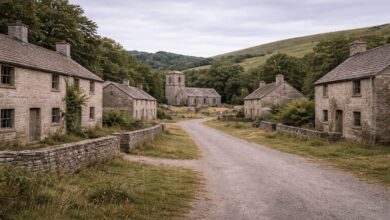
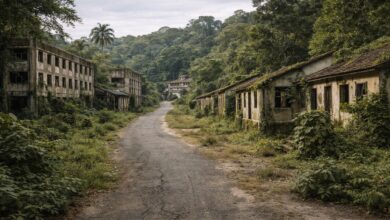
In the arid plains of Aragón, near the city of Zaragoza, the ruins of Belchite stand in deliberate stillness. Unlike many towns destroyed by war and later rebuilt, Belchite was left largely untouched after its devastation during the Spanish Civil War. The decision not to restore or erase the damage transformed the town into something unusual: a landscape where absence itself functions as memory.
Belchite is not a ghost town formed by economic decline or gradual abandonment. It is a place where destruction was preserved intentionally. Walls remain broken. Streets lead nowhere. Churches stand roofless. The town exists as a physical reminder of conflict without interpretive reconstruction. Its power lies not in what has been added, but in what has been left missing.
A town before destruction
Before the war, Belchite was a typical rural settlement. Its streets supported markets, homes, workshops, and places of worship. Life followed agricultural rhythms shaped by climate and local tradition. Buildings were functional rather than monumental, reflecting generations of incremental construction.
The town’s architecture carried traces of medieval and early modern development, but its identity was primarily communal. Belchite was not strategically famous. It became significant because of where the front lines moved, not because of what it represented beforehand. Similar human responses to silence and environment appear in ruins of Kuldhara.
This ordinariness matters. The town did not symbolize power before the war. It symbolized daily life.
The battle that reshaped the town
In 1937, Belchite became the site of one of the most destructive battles of the Spanish Civil War. Fighting between opposing forces turned the town into a prolonged urban battlefield. Artillery, aerial bombardment, and street fighting reduced much of it to rubble.
Civilians were trapped. Buildings collapsed. Churches, homes, and public spaces were destroyed systematically rather than incidentally.
When the fighting ended, Belchite was no longer habitable. The destruction was too extensive to repair quickly or safely.
A decision not to rebuild
After the war, authorities faced a choice. They could rebuild Belchite on its original site, or they could leave it as it was and construct a new town nearby. The latter option was chosen.
A new Belchite was built a short distance away. The old town was left in ruins. No comprehensive restoration was undertaken. The damaged structures remained exposed to weather and time.
This decision was not neutral. It embedded memory into the landscape by refusing closure.
Absence as a deliberate condition
Most post war reconstruction seeks to replace loss. Belchite did the opposite. It allowed loss to remain visible.
Streets were not cleared. Buildings were not stabilized beyond preventing immediate collapse. No attempt was made to return the town to functionality.
The ruins became a condition rather than a phase.
This approach transformed Belchite into a site of absence rather than recovery.
Architecture that remembers through damage
Walking through old Belchite today, visitors encounter walls without roofs, staircases leading nowhere, and facades punctured by shell impacts. The damage is not aestheticized. It is raw and uneven.
Church towers stand hollow. Windows frame sky instead of interior. Doorways open onto empty plots.
The architecture records violence without narration. It does not explain what happened. It shows what remains.
Silence without interpretation
One of Belchite’s defining qualities is its lack of interpretive overlay. There are signs identifying buildings, but few explanations that guide emotional response.
There is no staged memorial path. No reconstructed interiors. No dramatized exhibits.
This restraint allows the ruins to function as open evidence. Visitors are not told what to feel. They encounter absence directly.
Memory without restoration
Restoration often smooths irregularity. It fills gaps. Belchite refuses this smoothing.
Cracks remain open. Missing sections are not replaced. The town does not pretend continuity where it was broken.
As a result, memory here is not commemorated through symbol, but through exposure.
The past is not narrated. It is present.
The ethics of leaving ruins
Leaving a town unrestored raises ethical questions. Does preservation of destruction risk prolonging trauma. Does it turn suffering into spectacle.
In Belchite’s case, the absence of theatrical framing mitigates this risk. The town is not presented as entertainment. It is not animated.
The ruins exist quietly, without instruction.
This quietness distinguishes remembrance from exploitation.
A place without inhabitants
Unlike many preserved sites, Belchite has no residents. No daily life returns to the ruins. The new town nearby fulfills practical needs.
This separation reinforces the symbolic role of the old town. It is not a space of activity. It is a space of recall.
The lack of habitation prevents normalization.
Environmental exposure and slow change
Over decades, weather has altered Belchite gradually. Rain erodes mortar. Wind moves debris. Vegetation grows cautiously among stone.
This change is slow and visible. It does not erase destruction. It layers time onto it.
The town remains readable even as it ages.
Decay here is not neglect. It is continuation.
Fear, memory, and atmosphere
Visitors often describe Belchite as unsettling. This reaction is not caused by suggestion of threat, but by the absence of resolution.
The town feels unfinished. Human scale remains, but human presence does not.
Such environments disrupt expectation. Places meant for life do not function.
The mind responds with unease.
Absence as historical testimony
Belchite functions as testimony without words. It demonstrates what war does to civilian space. Not abstractly, but materially.
Homes are not symbolic. They are specific. Streets are not metaphors. They are navigable.
This specificity prevents generalization.
The town does not represent all wars. It represents one place affected by one conflict.
Why Belchite was left
The decision to leave Belchite unrestored was shaped by political, economic, and symbolic factors. Rebuilding elsewhere was more practical. Leaving ruins preserved a visible reminder of victory and cost.
Over time, that reminder outlived its original intent. It became a broader record of destruction rather than a statement of ideology.
Meaning shifted without physical change.
Memory beyond allegiance
Today, Belchite is approached less as a partisan symbol and more as a human one. The ruins do not declare allegiance. They declare damage.
This neutrality allows broader reflection. The town does not argue. It exists.
Absence becomes inclusive.
Comparison with rebuilt towns
Many towns destroyed during the same conflict were rebuilt entirely. Their streets function. Their damage is remembered through plaques or museums.
Belchite offers a different model. It externalizes memory rather than internalizing it.
The town itself becomes the archive.
The role of restraint
Belchite’s impact depends on restraint. If rebuilt, its message would soften. If heavily curated, it would narrow.
By leaving it largely alone, memory remains ambiguous and open.
This openness allows the site to remain relevant across generations.
Why absence endures
Absence endures because it resists resolution. Rebuilt places imply recovery. Unrestored places imply continuity of loss.
Belchite does not heal. It remembers.
This distinction explains its lasting power.
A town that does not conclude
Belchite has no ending. It was not restored, and it will not return to life. It remains between destruction and erasure.
This in between state is intentional.
The town does not ask to be understood fully. It asks to be acknowledged.
Absence as responsibility
By leaving Belchite unrestored, responsibility shifts to the observer. There is no narrative to accept or reject. Only evidence to confront.
The ruins do not explain why they exist. They show that they do.
This shifts memory from instruction to encounter.
A place where loss stays visible
Belchite stands as a reminder that not all wounds are meant to close. Some are preserved so they cannot be denied.
The town’s absence is not emptiness. It is presence without function.
In Aragón, under open sky, Belchite remains where it was left. Streets without footsteps. Walls without roofs. A town without restoration.
Left unrestored after war destruction, Belchite demonstrates how absence itself can function as memory. Not through monument or text, but through what remains missing. Related reflections on memory and perception can also be found in Centralia.
Horizon Report documents places shaped by memory, infrastructure, and human decisions. Our editorial approach focuses on what remains physically visible, how abandonment unfolds over time, and how interpretation is clearly separated from observable evidence.
For readers seeking deeper context, the following background articles explore how ghost towns emerge, why communities are left behind, and why preservation matters in understanding collective history.
- Abandonment And Ghost Towns
- What Is A Ghost Town
- Why Towns Are Abandoned
- Preserving Abandoned Places
Editorial transparency matters. Observations are grounded in site layout, materials, remaining structures, and documented timelines where available. Interpretive layers are presented as interpretation, not assertion.
Careful readers often notice details worth refining. Thoughtful feedback helps ensure accuracy, clarity, and long term editorial integrity.